

TechDef06: MOABI addressing the defence sector’s technological needs
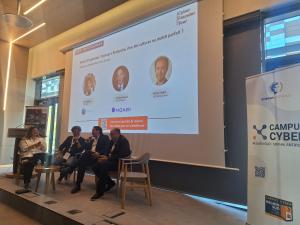
On 22 September 2026, MOABI took part in the first edition of TechDef06, organised at the Parc Phoenix in Nice on the initiative of the Alpes-Maritimes Departmental Military Delegation.And this was no ordinary technology fair. TechDef06 was conceived as a meeting place for two worlds that have much to learn from one another: on the one hand, the armed forces and their operational needs; on the other, the companies, start-ups, researchers and institutional players developing the technologies capable of meeting those needs.For this inaugural event, 40 exhibitors and 250 participants came together with a shared objective: to align the technologies developed in our region with the needs of the armed forces. MOABI was among the companies selected to showcase their technology.For us, this selection is particularly significant. It demonstrates the value that cybersecurity and software analysis technologies can bring to environments where control, trust and technological sovereignty are essential. Showcase the technology, don’t just talk about it Jonathan Brossard and Khalil were there to represent MOABI and, above all, to demonstrate in practice what our technology is capable of. Throughout the day, they were able to engage directly with military personnel, industry representatives and various stakeholders interested in our approach, as well as carrying out several demonstrations of the platform. These discussions provided an opportunity to address very practical issues. Modern systems rely on increasingly complex software chains. Proprietary software, open-source components, firmware, embedded systems and technologies from multiple suppliers can coexist within the same environment. In the defence sector, one question therefore becomes particularly important: how can the security of a software component be effectively verified when its source code is not necessarily available? It is precisely this type of issue that MOABI is working on. In an environment as demanding as the defence sector, trust in a supplier remains essential. But trust alone is not always enough. It must also be possible to verify. Discover a whole ecosystem centred on the needs of the defence sector TechDef06 also provided an opportunity to reconnect with a large part of our local ecosystem: technology companies, researchers, academics and institutions with whom we regularly engage in dialogue in Sophia Antipolis and on the Côte d’Azur.The technology park was particularly well represented, with 22 companies and stakeholders from the Sophia Antipolis ecosystem among the exhibitors. This diversity was, in fact, one of the highlights of the day. Cybersecurity, embedded artificial intelligence, Earth observation, communications, autonomous navigation, drones and 3D reconstruction: the technologies on display spanned a wide range of fields, yet all shared a common thread – their application to the operational needs of the defence sector.This is also what makes this type of event particularly valuable for a deep-tech company. A technology may be excellent in a laboratory or impressive during a demonstration. But it is only by engaging with those who might actually use it that one understands the constraints it will have to meet.Discussions with the military personnel present were therefore particularly interesting, allowing us to compare our vision of software security with their specific challenges and operating environments. From research to operational requirements This close relationship between research, industry and end-users is particularly important in the defence sector.Indeed, DMD06 describes TechDef06 as a forum designed to build bridges between those who develop technologies and those who will be able to apply them to meet operational needs.This philosophy resonates with us particularly strongly. MOABI emerged from advanced work in cybersecurity, reverse engineering and vulnerability analysis. But research only has a real impact when it can move beyond the laboratory, be commercialised and address concrete challenges.Being able to present our technology directly to representatives of the armed forces, gather their feedback and discuss their constraints is therefore a particularly interesting step. Our selection for this first edition of TechDef06 obviously does not mean that our technology has been adopted or validated by the Armed Forces.It is, however, an encouraging sign: the issues we are working on resonate with stakeholders in the defence sector. And for a company working on the security of software, systems and their supply chain, this is a discussion we wish to continue. A successful first edition, under the Nice sunshine Finally, it’s hard to talk about this day without mentioning the setting.TechDef06 took place at the Parc Phoenix in Nice, an outstanding garden that is home to over 2,500 plant species and a large wildlife area.A rather unusual setting in which to discuss cyber security, sovereignty, drones and defence technologies. A very beautiful setting, then. Very hot, too. But Jonathan and Khalil survived the Nice sunshine and, above all, came away having made numerous connections, had interesting technical discussions and established several contacts with whom to continue their exchanges. We would like to thank the Alpes-Maritimes Departmental Military Delegation and all the organisers for selecting MOABI and for this first edition of TechDef06.Thank you also to the military personnel, industry representatives, researchers, partners and institutional stakeholders who came to discover our technology and engage with our team. The defence of tomorrow will also be software-driven. And when a system becomes dependent on software, being able to understand and verify that software becomes a strategic issue. It is precisely in this area that we wish to continue contributing our expertise.